Telling TalesTelling Tales is my current project where folklore, gossip, myth and half-remembered family stories get pulled apart and reassembled. Each painting starts with something small - a rumour, a nursery rhyme, a witch trial detail, a Greek myth that doesn’t quite behave - and I follow the thread until it unravels into something stranger.
I’m interested in the moments where stories slip: where the funny becomes unsettling, where the grotesque becomes tender, where a throwaway detail suddenly reveals what a culture was terrified of. These aren’t illustrations of myths so much as sideways retellings.
Every painting has its own origin point, but they all circle the same questions about autonomy, girlhood, power, and the way narratives cling to bodies.
Below are the stories that sparked each work, the versions I tell myself while I’m painting:
-
![]()
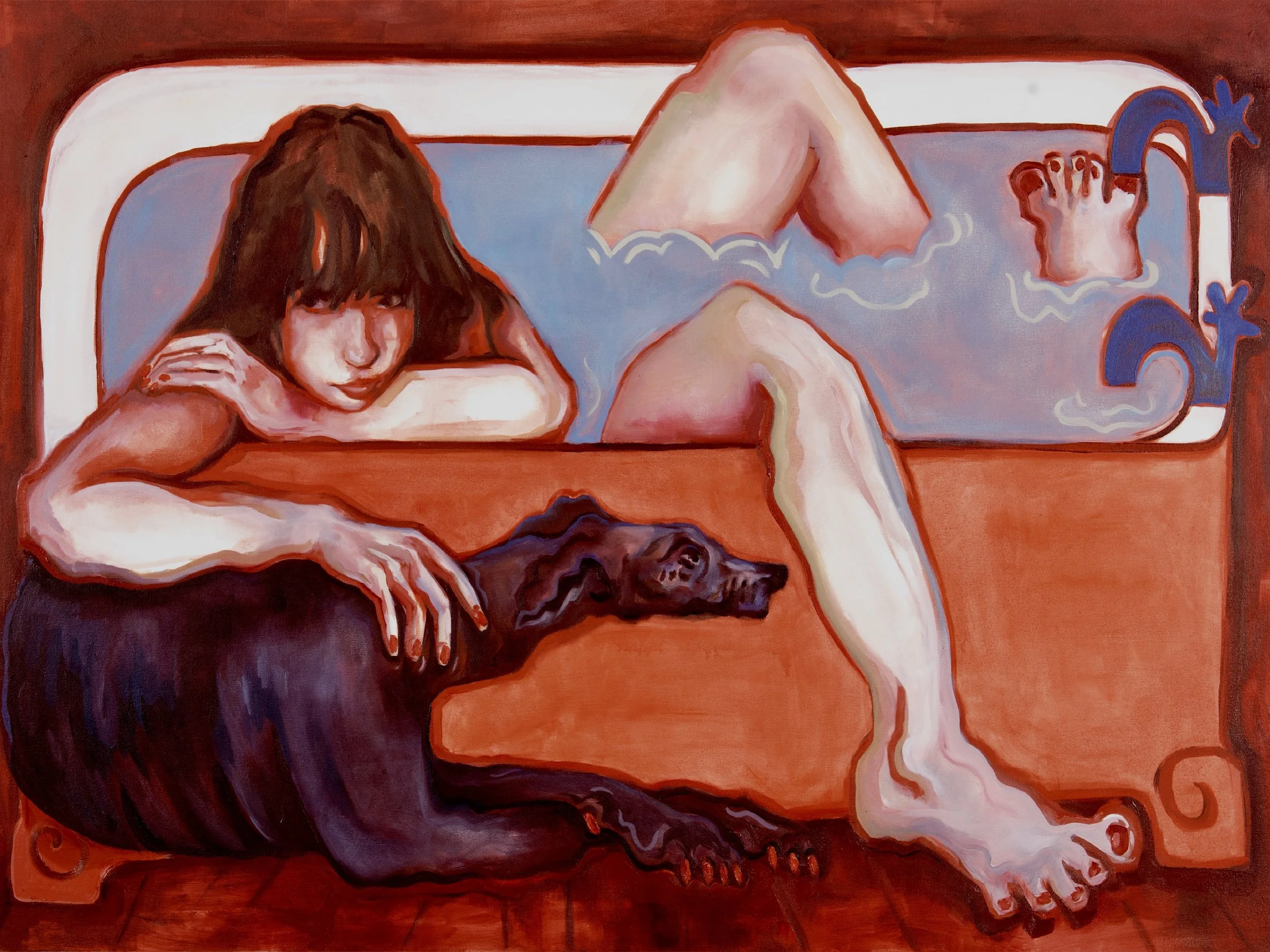
Bath Time
Oil on canvas, 95 x 135cm, 2026
Artemis (or Diana, depending on who’s telling it) is the goddess of the hunt, fiercely independent and famously uninterested in men. One day she’s bathing with her nymphs in a secluded pool; a space that’s meant to be private, sacred and absolutely not for male eyes.
Actaeon, a mortal hunter, wanders in by ‘accident’. Depending on which version you read, he’s either unlucky, nosy, or just in the wrong forest at the wrong time. Either way, he sees her naked, which is a massive no (as one of the Virgin goddesses seeing her naked was sacrilege)
Artemis angrily splashes water on him which turns him into a stag, and therefore wont be able to tell anyone of what he saw. Then, in the ultimate irony, he’s chased down and torn apart by his own hunting dogs. By Diana tries to stop him telling the story, yet the transformation makes the story unforgettable. Her attempt at erasure preserves the myth.
-
![]()
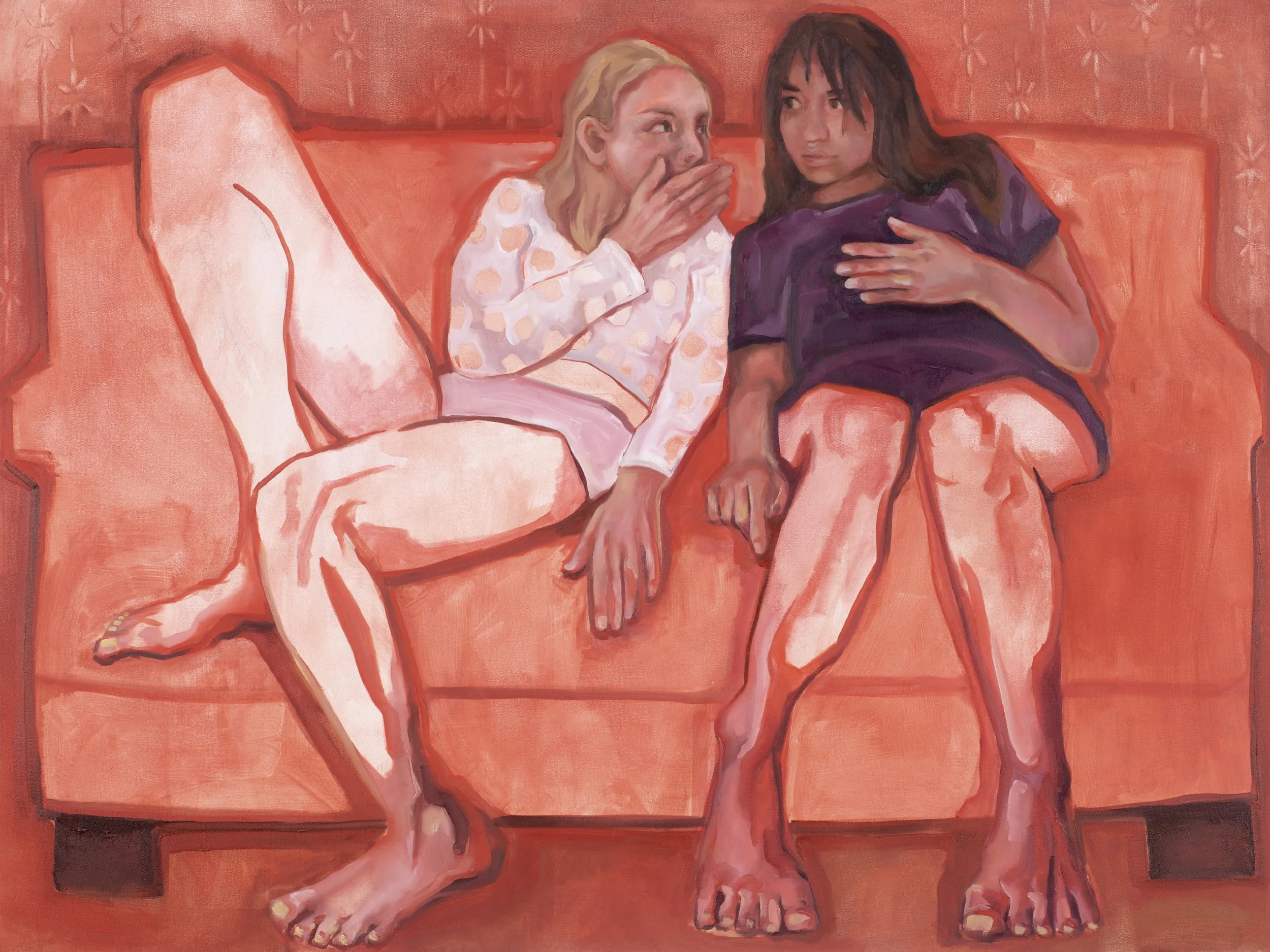
Gossip
Oil on Canvas, 90×110cm, 2025
At the heart of this painting is a very simple, everyday image: my sisters having a natter on the sofa. But like everything in Telling Tales, once you start following the thread, the "idle chatter" unravels into something much more complex.
The word "gossip" actually comes from the Old English God-sibb, meaning a "god-parent" or a close female friend present at a birth. It was originally a benevolent word for a strong female bond. It wasn't until the 16th century that "gossip" was weaponized, turned into a tool of control to break women’s solidarity. During witch trials and through satirical plays, women talking to one another was reframed as something idle, disruptive, or even dangerous. By mocking women for choosing their "gossips" over their husbands, the state and church turned a sacred social tool into a joke.
I’m interested in how we’ve inherited this dismissal. When men see women whispering, they often misread it through a "male gaze," seeing it as something "uncanny" or conspiratorial simply because they are excluded from the circle. In this painting, I wanted to reclaim that energy. It’s a celebration of "female grooming",not the kind done for a camera, but the evolutionary kind: the way we use shared stories and small talk to maintain the fabric of our communities. It’s about the intimacy of the sofa, where "telling tales" is actually a subversive act of sharing truth, power, and instinct.
-
![]()
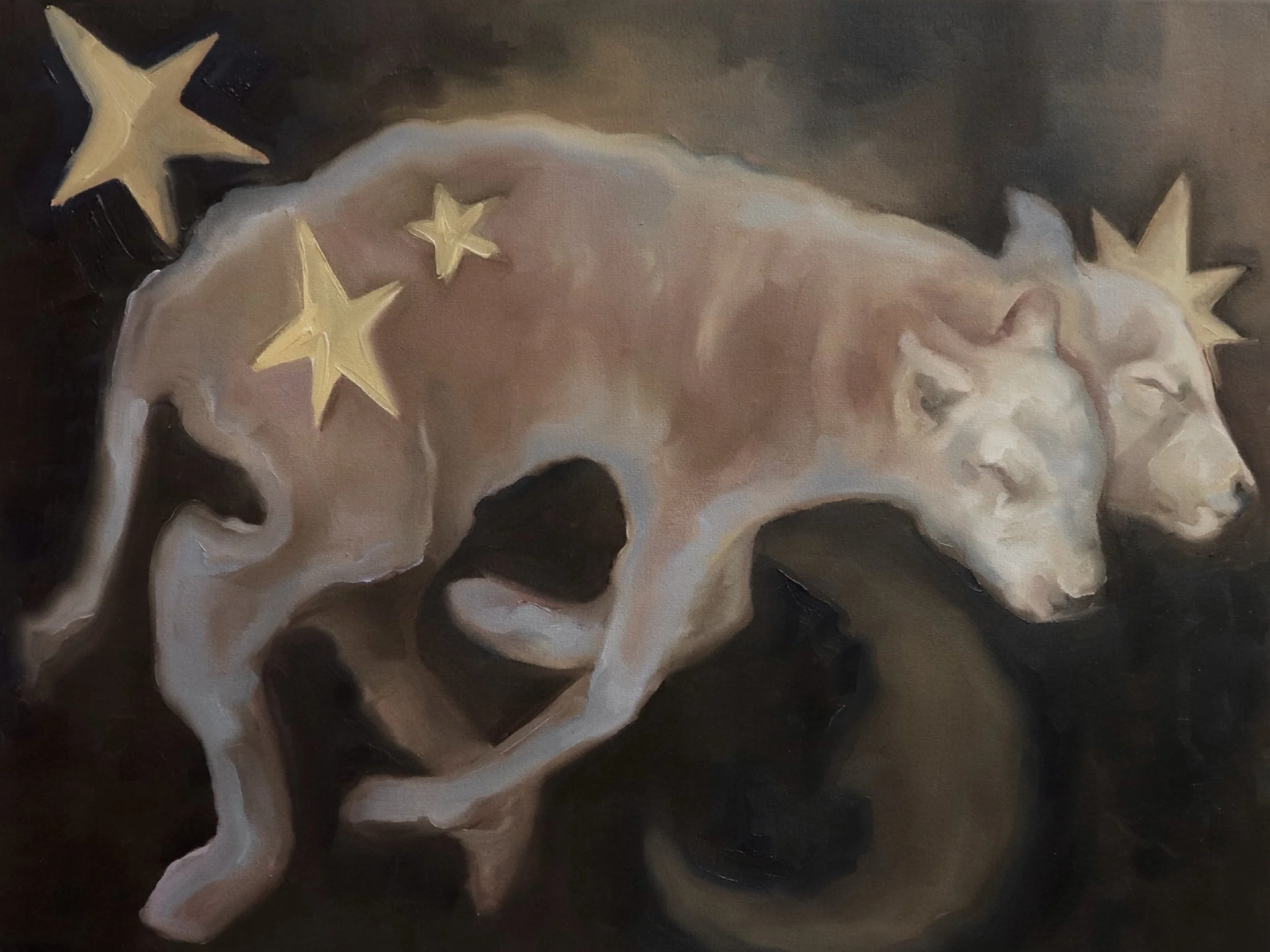
Moon Calf
Oil on Canvas, 40×50cm, 2025
This painting comes from the old concept of the "mooncalf". A word historically used for any calf born "wrong," as if the moon itself had interfered with its making. Before we understood genetics, a deformity in the herd was terrifying. Instead of science, people blamed it on: fairies taking revenge because you forgot to leave out a saucer of milk, a local witch cursing the herd, or just the moon tugging a bit too hard on a pregnant cow. it’s a way of projecting our anxieties about bodies and nature going off-script onto something supernatural.
-
![]()
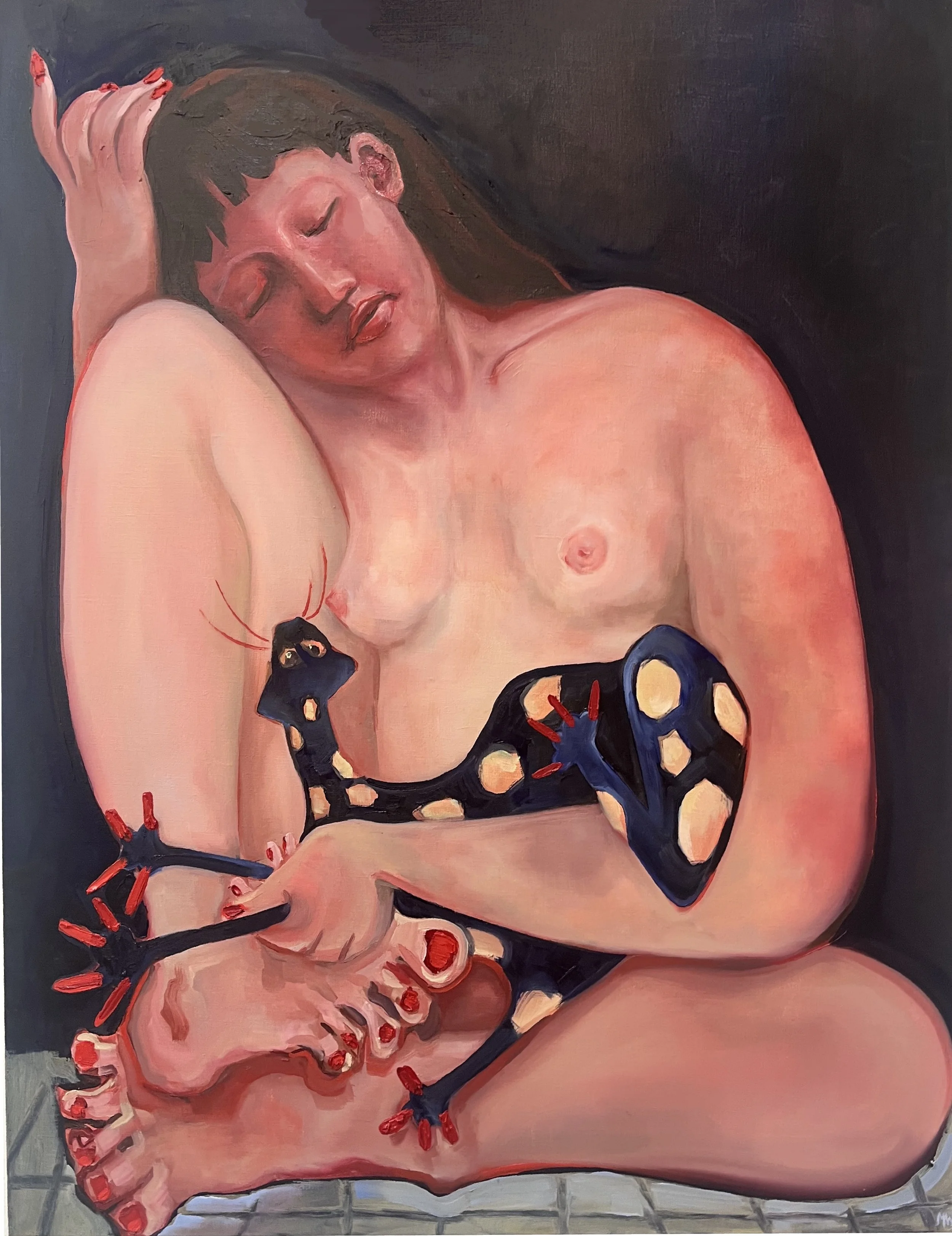
The Witches Tit
Oil on canvas, 90×70cm, 2026
This painting comes from the wonderfully bizarre bit of folklore known as the “witch’s tit” - the supposed third nipple witches were accused of having so they could feed their cat‑familiars. Yes, that was genuinely a thing. Early modern Europe was basically running around asking: Do you have a secret nipple? Is your cat drinking from it? Should we have a look?
People were actually inspected for this. Any mole, skin tag, or slightly dodgy freckle could be declared a “witch’s tit,” which says a lot about how frightened people were of women’s bodies…
What I love about this story is the mix of ridiculous and sinister. On one level, it’s hilarious - the idea of a woman breastfeeding a cat from a hidden nipple is so stupid it becomes iconic. But it was also used as “evidence” to accuse, shame, and punish women, especially those who were older, poor, or just inconvenient to have around.
My painting takes that whole mess literally, but instead of recreating the panic and finger‑pointing, I’ve put it in a quiet, domestic moment. No witchfinders, no hysteria - just a woman, a cat, and the absurdity of a myth that once had real consequences. It sits somewhere between funny, unsettling, and oddly tender, which is exactly the tension I’m interested in.
-
![]()
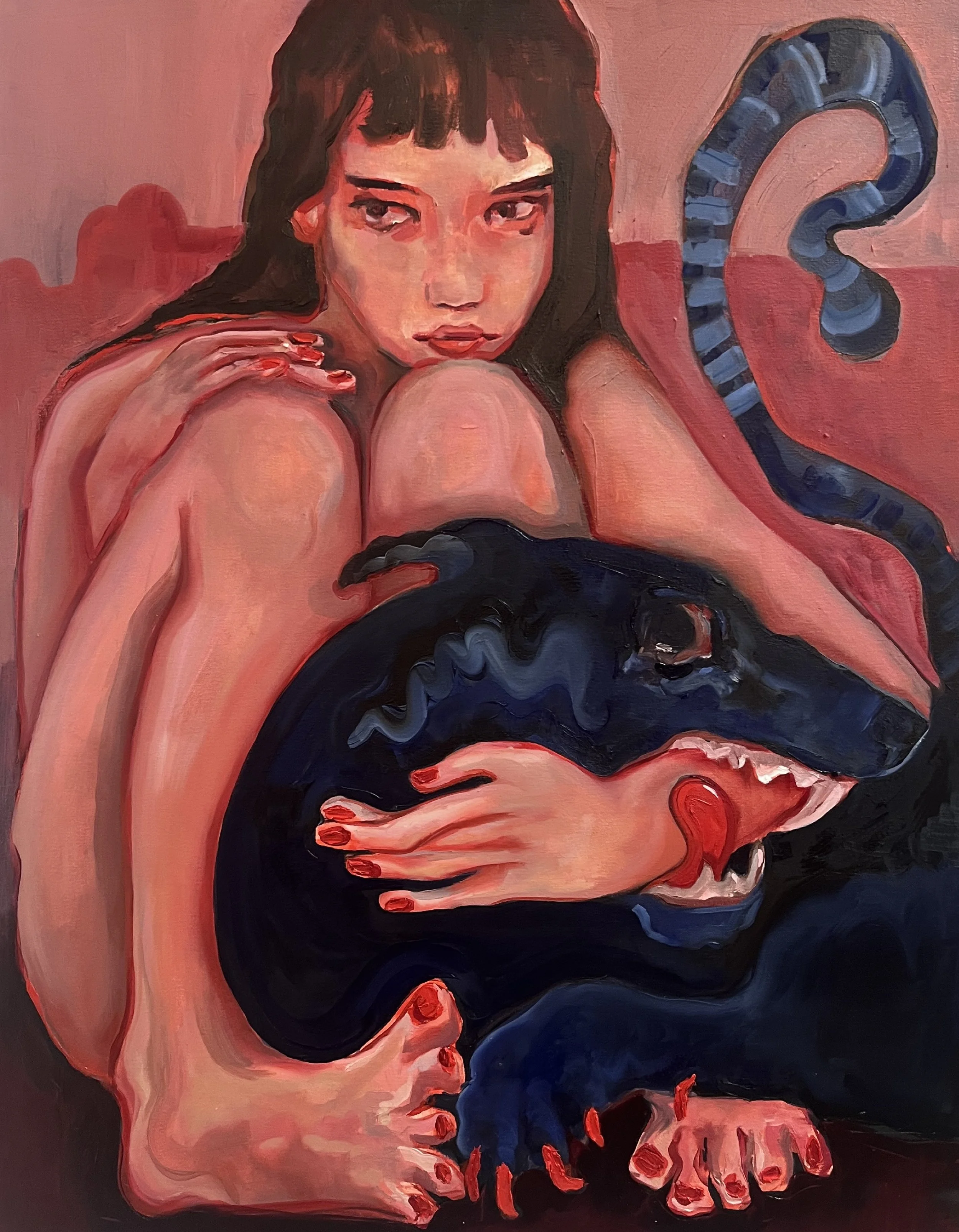
Bite the hand that feeds
Oil on canvas, 90×70cm, 2026
This story is built from folklore where dogs act as liminal creatures - symbols of a raw, human instinct that refuses to behave. It began with the 13th-century legend of Gelert, the faithful hound killed by his master because he was found covered in blood. The master assumed a violent attack, only to realize too late that the dog had actually saved his child from a wolf. It is a tragedy about how we project "danger" onto a creature whose actions we completely misread in the heat of the moment.
Woven into this is the myth of the Cŵn Annwn, the spectral, red-eared hounds that guard the thresholds between worlds. By giving the girl in the painting matching red nails, I’ve signaled that she is already "touched" by the story; she and the dog have stepped out of the mundane world together.
The title plays with the ancient idiom used to keep people, especially girls, grateful and quiet. In this painting, that logic falls apart. The "bite" here is a pre-language gesture, a moment where instinct overrides the story the world expects us to tell. It’s about that unsettling, tender space before a girl’s reaction is moralized or labeled as "too much," and where the "hand that feeds" isn't necessarily the one in charge.
-
![]()
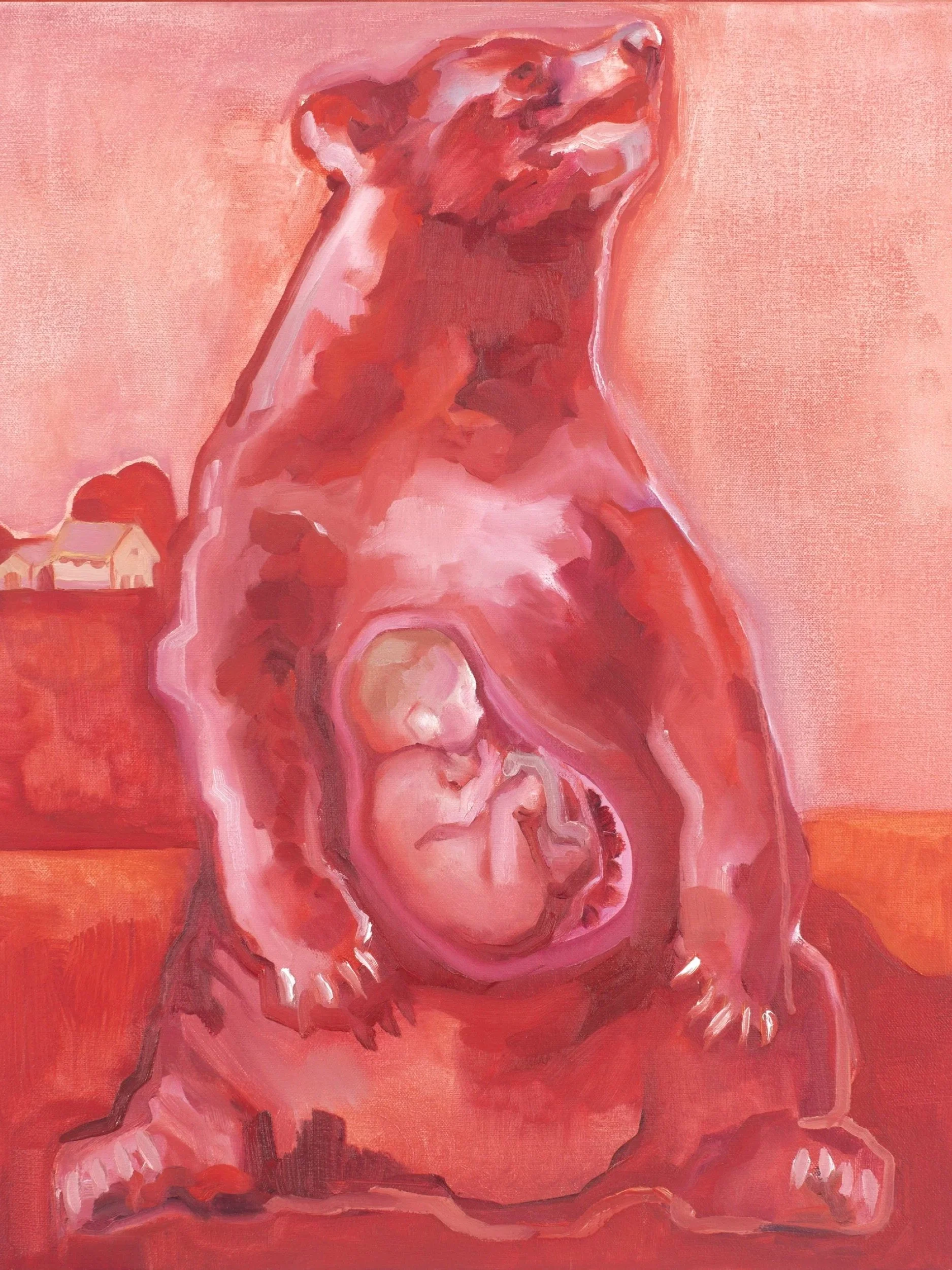
Mumma Bear
Oil on Canvas, 50×40cm, 2025
When you think of a "protector," what character is conjured in your brain? Usually, it is a hero from a story we’ve heard a thousand times: a knight guarding a village, or a damsel being plucked from the path of a dangerous animal by a brave hunter. But there is another figure held deep in the well of our collective memory, one that reaches back to our very beginnings. She is the "Mumma Bear". An archetype that doesn’t need a script because she is rooted in a primal, animalistic instinct that exists long before social constructs or patriarchal structures ever had a chance to name her.