This story is built from folklore where dogs act as liminal creatures - symbols of a raw, human instinct that refuses to behave. It began with the 13th-century legend of Gelert, the faithful hound killed by his master because he was found covered in blood. The master assumed a violent attack, only to realize too late that the dog had actually saved his child from a wolf. It is a tragedy about how we project "danger" onto a creature whose actions we completely misread in the heat of the moment.
Woven into this is the myth of the Cwn Annwn, the spectral, red-eared hounds that guard the thresholds between worlds. By giving the girl in the painting matching red nails, I've signaled that she is already "touched" by the story; she and the dog have stepped out of the mundane world together.
The title plays with the ancient idiom used to keep people, especially girls, grateful and quiet. In this painting, that logic falls apart. The "bite" here is a pre-language gesture, a moment where instinct overrides the story the world expects us to tell. It's about that unsettling, tender space before a girl's reaction is moralized or labeled as "too much," and where the "hand that feeds" isn't necessarily the one in charge.
This story is built from folklore where dogs act as liminal creatures - symbols of a raw, human instinct that refuses to behave. It began with the 13th-century legend of Gelert, the faithful hound killed by his master because he was found covered in blood. The master assumed a violent attack, only to realize too late that the dog had actually saved his child from a wolf. It is a tragedy about how we project "danger" onto a creature whose actions we completely misread in the heat of the moment.
Woven into this is the myth of the Cwn Annwn, the spectral, red-eared hounds that guard the thresholds between worlds. By giving the girl in the painting matching red nails, I've signaled that she is already "touched" by the story; she and the dog have stepped out of the mundane world together.
The title plays with the ancient idiom used to keep people, especially girls, grateful and quiet. In this painting, that logic falls apart. The "bite" here is a pre-language gesture, a moment where instinct overrides the story the world expects us to tell. It's about that unsettling, tender space before a girl's reaction is moralized or labeled as "too much," and where the "hand that feeds" isn't necessarily the one in charge.

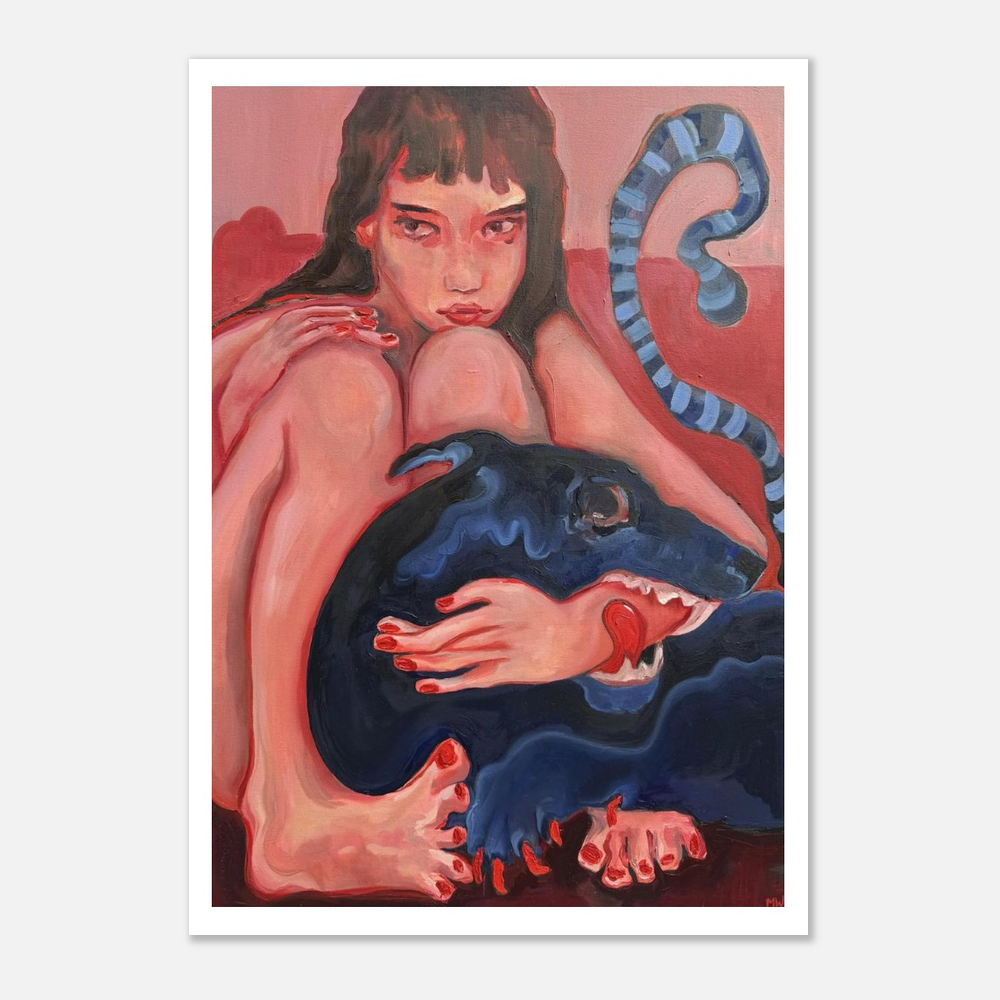 Image 1 of 2
 Image 2 of 2